KC

free forever · open source · GPL-3.0 · macOS

Koda-C

Koda-C holds AI-produced work at a closed gate until an independent review has been read and acknowledged by the human who owns it.

Clone and run · Node.js 22.18 or later · no build step, no dependencies

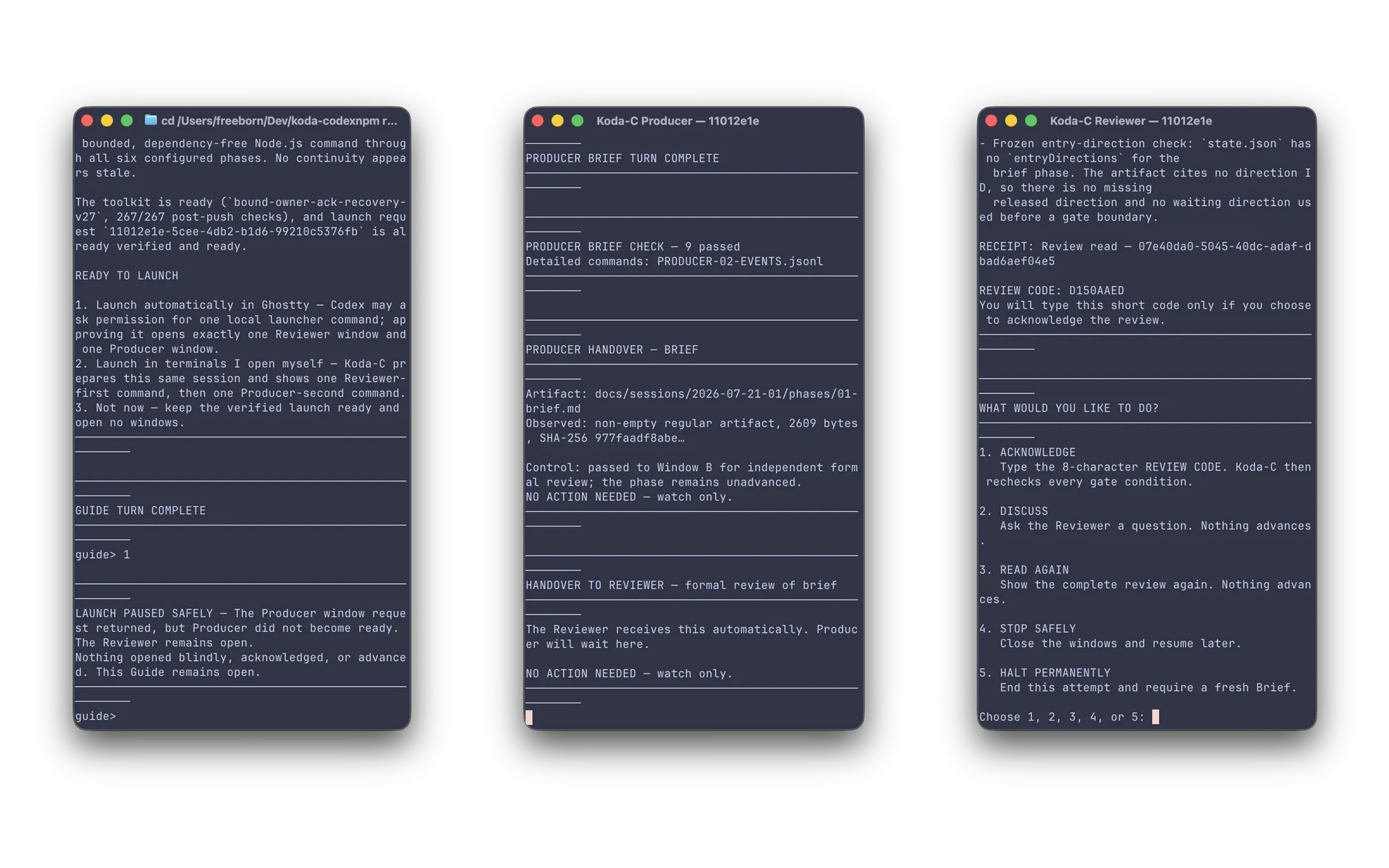
The three Koda-C seats side by side in bounded terminal panels — the Guide console, the Producer with a handover brief, and the Reviewer asking for the receipt acknowledgement.

An entry for OpenAI Build Week, built with Codex

Koda-C is a small command-line tool wrapped around one idea: a review that was delivered is not a review that was heard. It formalizes the phase method I already use when directing AI-built products, turned into software over one weekend in July 2026 as my first project with Codex and submitted to OpenAI Build Week in the Developer Tools track. The whole collaboration is preserved in the repository, failed runs and repairs included, because a tool that enforces evidence discipline should be able to show its own. Everything a judge needs ships in the clone: the demo generates its own sample project, and there is no account, API key, network service, or build step. The long version starts in the process document.

the gate

Four facts must agree before anything moves

Koda-C will not advance a phase until the artifact exists, an independent review is bound to its current bytes, the verdict permits movement, and the review's unique receipt appears in the owner's approval ledger. If any one of those fails, the gate stays closed and says so plainly: nothing advanced. Its truth is re-derived from ordinary files every time, so there is no hidden state to drift out of sync.

Read about the process →

the receipt

Delivery is not acknowledgement

Koda-C was built for a specific failure: a review can exist, be delivered, and still never enter the decision that moves the work forward. The receipt separates those two proofs. To open the gate, the owner has to open the review and take its unique phrase, so ignoring a review stops being a passive omission. The receipt does not prove comprehension; it raises the floor.

Read the full product README →

more capabilities

Plain files, zero dependencies

The gate and every status readout are re-derived from ordinary files on disk. No database, no service, no npm install.

Command Manual →

A configurable relay

The reference chain runs Brief, Orient, Plan, Produce, Live, Summary, with review at every gate. Phase order lives in project configuration, so a writing or research project keeps the same discipline under its own phases.

Process →

Three visible seats

One persistent Guide, a watch-only Producer, and a separate owner-facing Reviewer. Koda-C opens them automatically in Ghostty on macOS, or prepares the same bound session for terminals you open yourself.

Quick Start →

Evidence, not promises

Failed first attempts, their repairs, security audits, and full test transcripts stay in dated files and Git history instead of being summarized away.

Testing ledger →

technology

What it's built with

language / runtime
TypeScript, compiled to dependency-free JavaScript that runs directly on Node.js 22.18 or later. The intended long-term core is a headless Rust engine speaking the same plain-file contract.
interface
Bounded terminal panels for all three seats. Ghostty is an optional macOS adapter that opens the windows; an interface may present and request actions, but it never becomes gate truth.
storage
Ordinary files on disk, with Git providing the immutable pushed close. Local-first by construction: no accounts, no telemetry, no network service.
built with
Codex, running GPT-5.6 Sol at extra high reasoning effort, in one long session from first commit to submission. The same model family also sits in the product's own seats.
tested on
MacBook Pro 14-inch (Apple M5, 32 GB), macOS Tahoe 26.5.1. The one machine everything on this site is built and certified on.

screenshots

In use

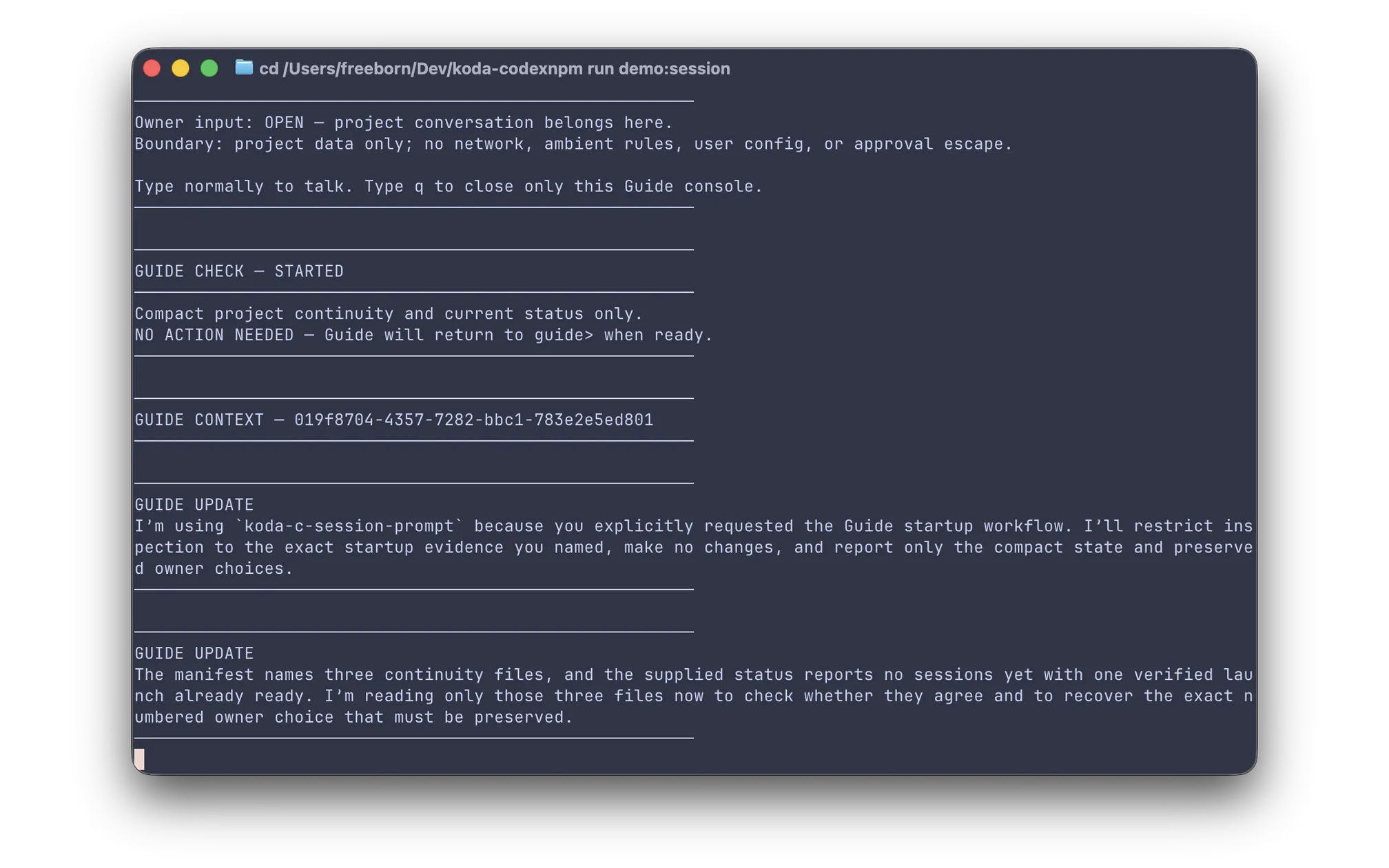
The Guide seat in a bounded terminal panel, reporting a gate check, the session context hash, and its compact status updates.
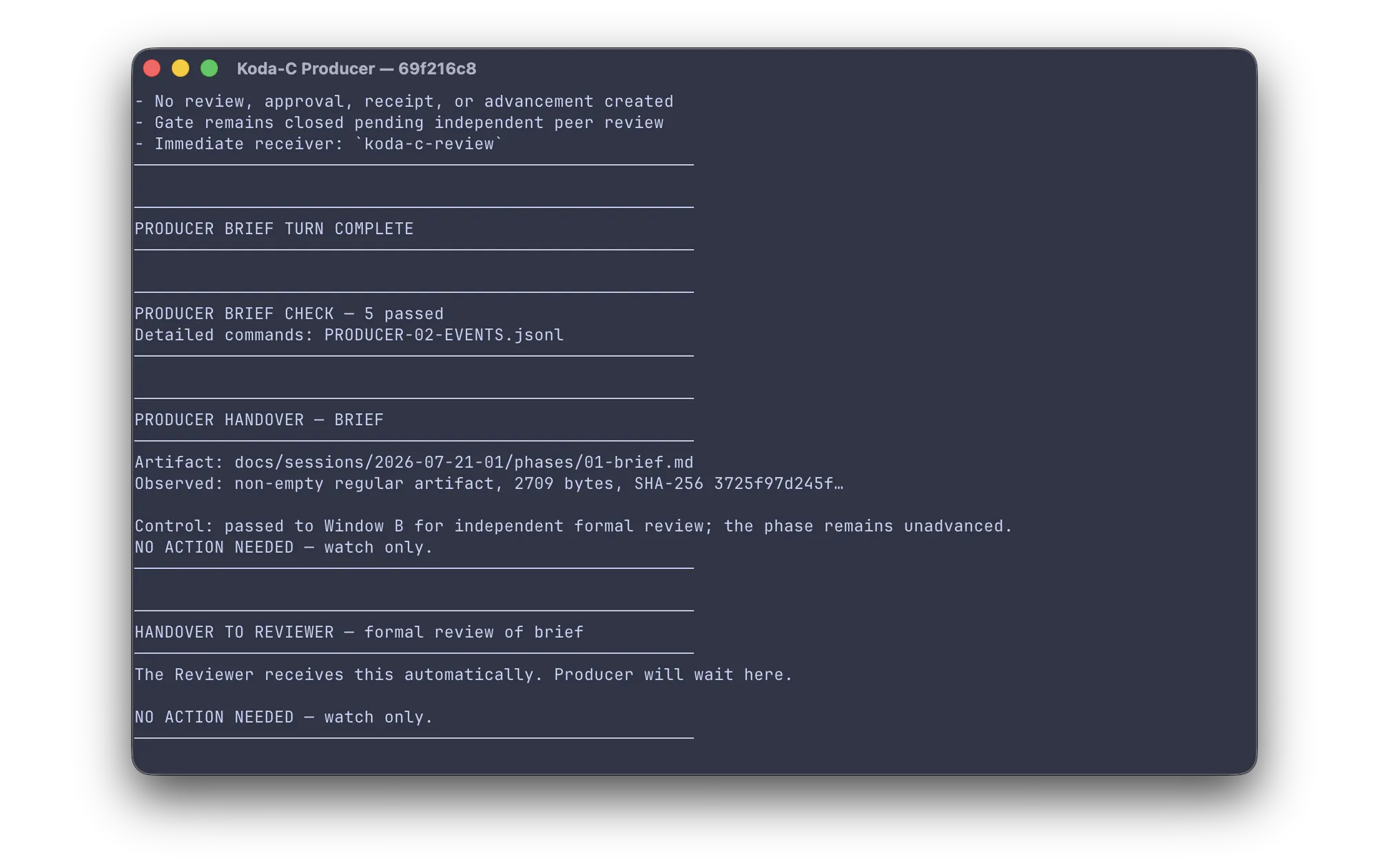
The watch-only Producer seat working through a phase in its own terminal window.
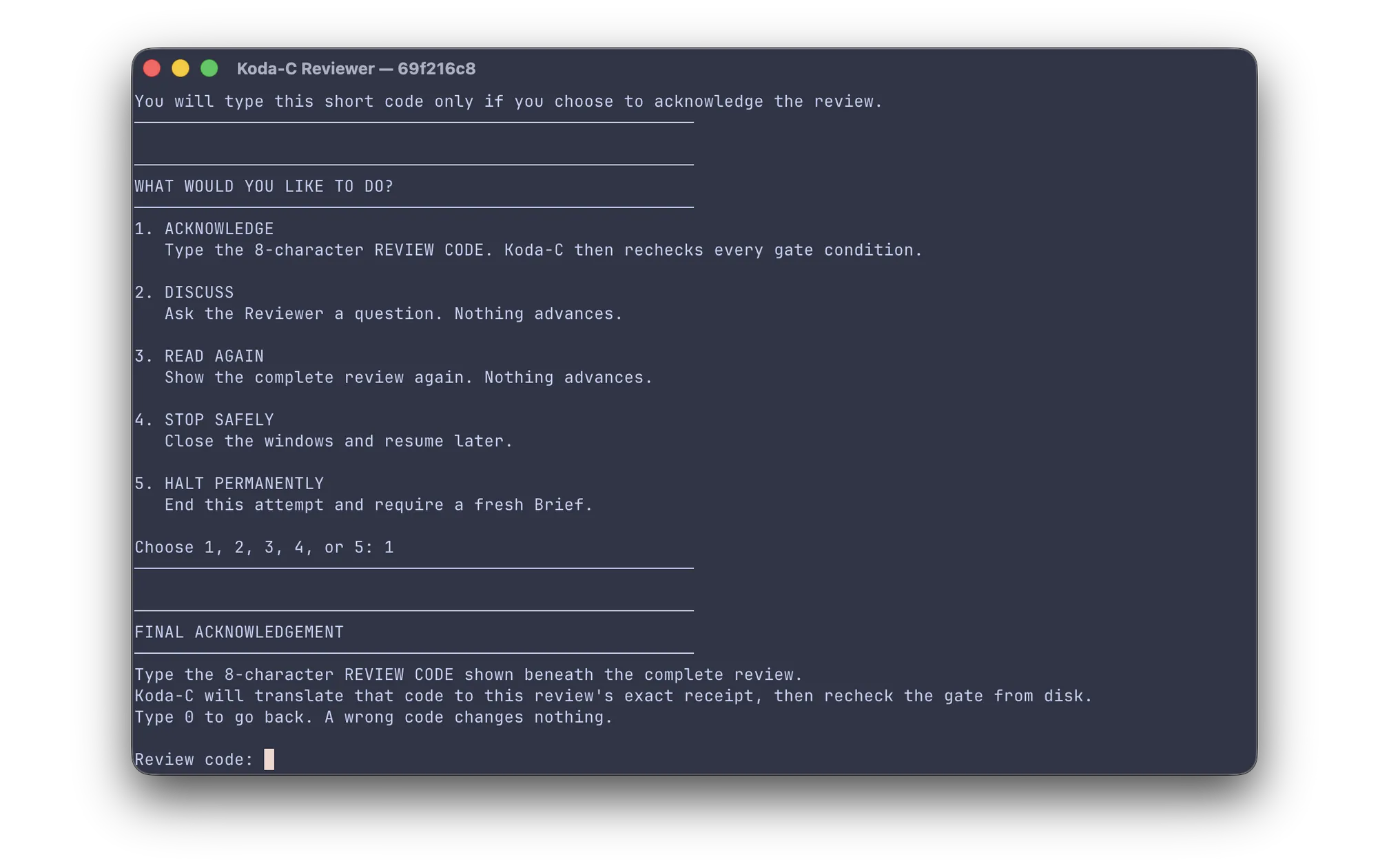
The Reviewer seat presenting the acknowledgement choices and asking for the review code beneath the complete review.

story

Why this exists

I direct software as a designer, across C++, Swift, and Rust, with models doing much of the production. The phase method inside Koda-C, brief, orient, plan, produce, live, summary, with an independent review between every phase, is simply how I already work. What kept bothering me was how easy it is for a review to be technically present and practically absent. The work moves on, the review scrolls past, and nobody deliberately decided that.

Koda-C started Saturday morning, July 18, 2026, and reached the state on this page by Monday morning. Roughly 51 elapsed hours, my first project with Codex, and I deliberately let it build in its own engineering order: the discipline lives in the product, not in the process that made it. The dated commits and the recorded failed tests are the honest version of how it went, and they stay in the repository.

What ships now is a TypeScript reference of an idea I intend to carry further: a headless Rust core, richer clients, and seats that different agents can occupy. The center will not change. The verdict controls movement, and the receipt proves the review entered the loop.

Kristian
questions

Frequently asked

How do I install it?

Clone the repository and run it. There is no npm install and no build step; the committed CLI is the test build. init --demo generates its own sample project, so the one-minute proof needs nothing beyond Node.js 22.18+ and Git. Full steps live in the Quick Start.

Free forever?

Yes. Free forever, GPL-3.0-only, no accounts, no telemetry, no network service.

Do I need an API key or a model?

Not for the mechanical gate. The one-minute demo runs without any model, key, account, or network. The complete managed session uses Codex for the Producer and Reviewer seats; the core itself does not require a model.

Which platforms are tested?

macOS 26.5.1 arm64 with Node.js 26 is the only personally tested release platform. The core has no macOS filesystem dependency, but no other platform is claimed as certified yet. The testing ledger records exactly what has been run.

Can other agents take the seats?

That is the architectural direction: the disk-separated seats leave room for Codex CLI in Producer while Claude Code occupies Reviewer, or the reverse. Today's managed runner is Codex-only, and any additional provider must prove isolation, permissions, recovery, and review quality before Koda-C trusts it. See the security boundary.

License
GPL-3.0-only
Platform
macOS 26 arm64 (tested) · Node.js 22.18+